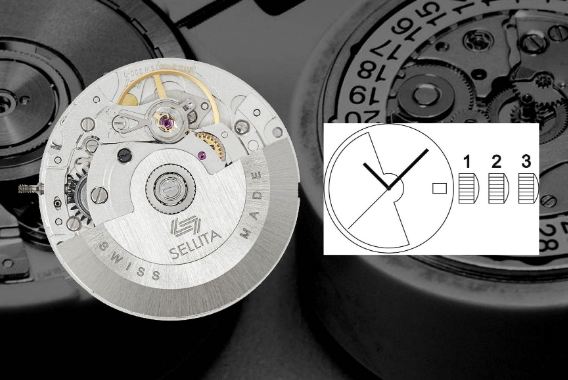
A quality timepiece is more than just an instrument for telling time; it’s a piece of intricate engineering. The Sellita SW500 is a renowned automatic chronograph movement, celebrated for its reliability and performance. It powers countless luxury watches, making it a favorite among watch enthusiasts and manufacturers. However, like any precision machine, it requires occasional calibration to maintain its accuracy. If your watch is running a bit fast or slow, learning how to calibrate a Sellita SW500 can restore its performance. This guide will walk you through the process, providing the knowledge you need to keep your timepiece in perfect working order. We will cover the tools you’ll need, the steps for preparation, and the detailed process of making adjustments.
- Understanding the Sellita SW500 Movement
- Why Does a Watch Movement Need Calibration?
- Essential Tools for Calibrating Your Watch
- Preparing Your Watch for Calibration
- Step-by-Step: How to Calibrate a Sellita SW500
- Common Mistakes to Avoid During Calibration
- Professional vs. DIY Watch Calibration
- When to Seek Professional Help
- Maintaining Your Calibrated Watch
- Conclusion
Understanding the Sellita SW500 Movement
Before diving into the calibration process, it’s essential to understand what makes the Sellita SW500 tick. This movement is a Swiss-made automatic chronograph, which means it self-winds with the motion of your wrist and includes a stopwatch function. It is often compared to the ETA Valjoux 7750, as it shares a similar design and functionality, making it a robust and dependable “workhorse” movement in the industry. The SW500 operates at a frequency of 28,800 vibrations per hour (4Hz), which contributes to its smooth second-hand sweep and accuracy. It features 25 jewels, which are synthetic rubies placed at high-friction points to reduce wear and tear, ensuring longevity. Understanding these basics helps you appreciate the complexity of the machine you are about to adjust. Knowing how to calibrate a Sellita SW500 is not just a technical skill; it’s about connecting with the heart of your watch.
Why Does a Watch Movement Need Calibration?
Even the most well-crafted mechanical watches can lose or gain time. This is a normal occurrence resulting from various factors. Gravity, for instance, can have a subtle effect on the delicate balance wheel and hairspring, causing slight variations in timekeeping depending on the watch’s position. Temperature fluctuations also play a role; metal components expand when warm and contract when cold, which can alter the hairspring’s effective length and change the rate. Furthermore, magnetism is a common culprit. Everyday objects like speakers, laptops, and smartphones can magnetize the movement’s components, causing the watch to run significantly fast. Over time, the lubricants inside the movement can also degrade, increasing friction and affecting accuracy. Regular calibration, or regulation, corrects these deviations, ensuring your watch performs within the manufacturer’s specifications.
Essential Tools for Calibrating Your Watch
Attempting to calibrate your watch without the proper tools is a recipe for disaster. The internal components are incredibly delicate, and a single slip can cause irreparable damage. To safely and effectively learn how to calibrate a Sellita SW500, you will need a specific set of tools. First, a watch case back opener is necessary to access the movement. The type you need depends on your watch case—some are screw-down, while others are snap-on. A movement holder will secure the movement while you work, preventing it from shifting. You will also need a set of non-magnetic tweezers and a watchmaker’s screwdriver for making tiny adjustments. A loupe or magnifying glass is crucial for seeing the small parts clearly. Finally, a timegrapher is highly recommended. This device measures the watch’s rate, beat error, and amplitude, giving you precise data to guide your adjustments.
Using a Timegrapher for Accurate Measurement
A timegrapher is an indispensable tool for serious watch calibration. It provides a real-time analysis of the movement’s health and performance. The device listens to the “tick-tock” sound of the watch through a sensitive microphone and translates it into key metrics. The most important metric for calibration is the rate, which shows how many seconds per day the watch is gaining or losing. Another is the beat error, which measures the consistency of the balance wheel’s swing. An ideal beat error is 0.0 milliseconds. The amplitude indicates the degree of rotation of the balance wheel. A healthy amplitude for a Sellita SW500 is typically between 270 and 315 degrees. Using a timegrapher transforms calibration from guesswork into a precise science, allowing you to see the immediate effect of your adjustments and achieve a much higher degree of accuracy.
Preparing Your Watch for Calibration
Preparation is key to a successful and damage-free calibration. Start by finding a clean, well-lit, and dust-free workspace. A stray piece of dust getting into the movement can cause significant problems. Lay down a soft mat to protect the watch from scratches. Before you begin, ensure your watch is fully wound to provide consistent power during testing and adjustment; this ensures the amplitude is stable. If it’s an automatic watch like one with an SW500, you can wind it manually by turning the crown about 30-40 times. Once fully wound, you can place it on the timegrapher to get a baseline reading of its performance. Record the initial rate, beat error, and amplitude. This data will tell you what needs to be adjusted. Finally, carefully open the case back using the appropriate tool. Take your time with this step to avoid scratching the case.
Step-by-Step: How to Calibrate a Sellita SW500
With the case back removed and the movement exposed, you can begin the calibration. Look for the balance wheel, which is the component that oscillates back and forth. Near it, you will see two small levers or screws on the balance cock (the bridge holding the balance wheel). These are the regulators. One lever adjusts the rate (making the watch run faster or slower), and the other adjusts the beat error.
- Adjusting the Rate: The rate regulator lever moves the effective length of the hairspring. To make the watch run slower, you will move this lever toward the stud that holds the hairspring. To make it run faster, move it away from the stud. Make very small adjustments—a movement of less than a millimeter can change the rate by several seconds per day.
- Adjusting the Beat Error: The second lever adjusts the position of the hairspring stud to equalize the balance wheel’s swing. The goal is to get the beat error as close to 0.0ms as possible.
- Check and Repeat: After each tiny adjustment, place the watch back on the timegrapher to see the result. This is an iterative process. Adjust, measure, and repeat until the rate is within your desired range (e.g., +/- 5 seconds per day) and the beat error is minimal.
Patience is crucial. Rushing the process is the quickest way to damage the delicate hairspring.
Common Mistakes to Avoid During Calibration
Calibrating a watch movement is a delicate task, and several common mistakes can lead to costly damage. One of the biggest errors is using the wrong tools, especially magnetic ones. Magnetizing the hairspring will cause it to stick to itself, making the watch run extremely fast. Always use non-magnetic tweezers. Another frequent mistake is applying too much force. The regulator levers require only the slightest nudge. Pushing too hard can bend or break a component. It is also vital to avoid touching the hairspring directly. Oils and dirt from your fingers can disrupt its function, and it is incredibly easy to deform. Finally, a mistake many beginners make is not using a timegrapher. Without it, you are adjusting blindly and relying on waiting 24 hours to see the results, which is inefficient and inaccurate.
Professional vs. DIY Watch Calibration
Deciding whether to calibrate your watch yourself or take it to a professional depends on your confidence, tools, and the value of your watch. The DIY approach can be rewarding and cost-effective if you enjoy hands-on projects and are willing to invest in the right tools. It offers a deeper connection to your timepiece. However, the risks are significant. A small mistake can lead to an expensive repair bill that far exceeds the cost of a professional service.
A professional watchmaker has the experience, specialized equipment, and steady hands to perform the calibration safely and accurately. They can also inspect the watch for other issues, such as worn parts or dried lubricants, that might be affecting its performance.
Aspect | DIY Calibration | Professional Calibration |
|---|---|---|
Cost | Initial tool investment; free afterward | Service fee per calibration |
Risk | High risk of damaging the movement | Very low risk; insured work |
Accuracy | Good with a timegrapher, but requires practice | Highly accurate and precise |
Time | Can be time-consuming for beginners | Quick turnaround time |
Additional Services | None | Includes inspection, cleaning, pressure testing |
For an expensive watch or if you are not comfortable with the risks, professional service is the wisest choice.
When to Seek Professional Help
While learning how to calibrate a Sellita SW500 is possible, there are times when it is best to leave it to the experts. If your watch has suffered a significant impact from being dropped, it needs more than just calibration. Internal components could be damaged, requiring a full inspection and service. Similarly, if the watch stops running altogether or if the crown feels gritty or difficult to turn, these are signs of a deeper mechanical issue. Water damage is another critical situation that demands immediate professional attention to prevent rust and corrosion. If you’ve attempted calibration and find you cannot get the beat error below 1.0ms or if the amplitude is very low (below 220 degrees when fully wound), it often indicates that the movement needs a full cleaning and oiling, which is a job for a professional. For those interested in the latest trends in luxury goods, a visit to a lifestyle site like Trand Magazine can offer more insights.
Maintaining Your Calibrated Watch
After successfully calibrating your Sellita SW500, you’ll want to keep it running accurately for as long as possible. Regular maintenance is key. Avoid exposing your watch to strong magnetic fields. Be mindful of placing it near speakers, tablets, and magnetic clasps on bags. Try to avoid extreme temperature shocks, like going from a hot tub into cold air. While the SW500 has good shock protection, it’s still wise to avoid wearing your watch during high-impact sports. Finally, a full movement service is recommended every 5-7 years, as advised by institutions like the American Watchmakers-Clockmakers Institute. During a service, a watchmaker will completely disassemble the movement, clean every part, replace any worn components, reassemble it with fresh lubricants, and calibrate it to perfection. This regular care will ensure your timepiece provides many years of reliable service.
Conclusion
Learning how to calibrate a Sellita SW500 is an accessible skill for a careful and patient watch enthusiast. By understanding the movement’s mechanics, investing in the proper tools, and following a methodical process, you can make precise adjustments to keep your watch running accurately. The key is to be gentle, make small changes, and use a timegrapher to guide your work. While the satisfaction of maintaining your own timepiece is immense, it’s also important to recognize when a task is best left to a professional watchmaker. Proper care and timely calibration will ensure your watch, powered by its robust SW500 movement, remains a reliable and treasured companion for years to come.
Key Takeaways
- The Sellita SW500 is a reliable Swiss automatic chronograph movement that can be regulated for accuracy.
- Calibration is needed to counteract effects from gravity, temperature, magnetism, and aging lubricants.
- Essential tools include a case back opener, non-magnetic tweezers, and a timegrapher for precise measurements.
- The calibration process involves making tiny adjustments to the rate and beat error levers near the balance wheel.
- Patience and precision are critical to avoid damaging the delicate hairspring.
- For valuable watches or complex issues, seeking a professional watchmaker is the safest option.
Frequently Asked Questions (FAQ)
Q1: How accurate should a Sellita SW500 be?
A: A standard grade Sellita SW500 is typically rated for an accuracy of around +/- 12 seconds per day. However, with careful calibration, it’s often possible to regulate it to within +/- 5 seconds per day or even better.
Q2: Can I damage my watch by calibrating it myself?
A: Yes, there is a significant risk. The hairspring is incredibly delicate and can be easily damaged if you slip or apply too much force. This is why using the correct tools and having a steady hand is crucial.
Q3: How often does a Sellita SW500 need to be calibrated?
A: You only need to calibrate it if you notice it’s not keeping time accurately. However, a full service, which includes cleaning, lubricating, and calibration, is recommended every 5-7 years to maintain the movement’s health.