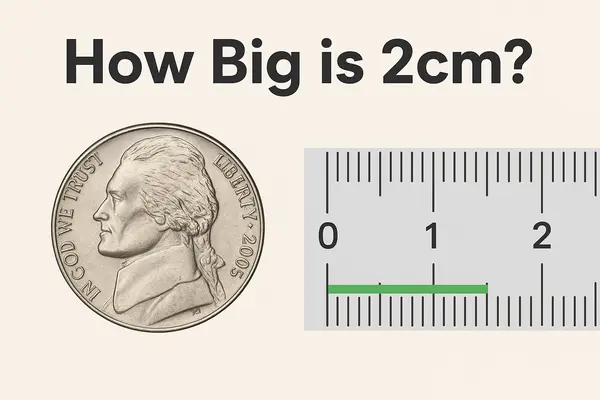
Have you ever seen a product description, medical report, or recipe with a measurement like 2 centimeters? You are not alone. Many people find it hard to imagine just how big is 2cm without a reference.
- What is a Centimeter? A Metric System Primer
- How Does 2cm Compare to an Inch?
- Visualizing 2cm: Common Household Objects
- The Importance of 2cm in the Medical Field
- 2cm in Product Design and Technology
- 2cm in Nature: From Insects to Gemstones
- Metric vs. Imperial: A Quick Comparison
- The Role of Measurement in Science and Education
- Cooking and Crafts: 2cm in Daily Life
- Conclusion: Putting 2 Centimeters into Perspective
You might wonder, is it large or small? Knowing this simple measurement is important. It can help you with shopping online or understanding health information.
This guide will make the size of two centimeters clear. For example, you will see easy comparisons and real-life uses for 2 cm. In addition, you’ll discover why this small unit matters.
We’ll look at how big 2 cm is compared to common objects. We will also see its role in medicine, technology, and the metric system. By the end, you’ll easily picture what 2 cm looks like.
What is a Centimeter? A Metric System Primer
Before we answer how big is 2cm, let’s talk about centimeters. A centimeter, or cm, is a unit of length in the metric system. This system is used by most countries because it is simple and based on tens. Each unit changes by a power of ten, making conversions quick and easy.
The main unit for length in the metric system is the meter. One centimeter is one-hundredth of a meter. The prefix “centi-” means “one hundredth.” So, there are 100 centimeters in a meter.
This system helps us measure things the same way across the world. For example, it keeps science, business, and international work more consistent. In the United States, people often use inches and feet. However, these have more complicated conversions. That’s why many people find the metric system easier for global standards.
How Does 2cm Compare to an Inch?
Many people in the United States use inches for small measurements. So, to see how big is 2cm, let’s compare it to an inch.
One inch is defined as 2.54 centimeters. This means 2 cm is smaller than one inch. In fact, 2 cm equals about 0.79 inches.
Think of 2 cm as a little more than three-quarters of an inch. This is a handy way to picture it, especially if you don’t have a ruler nearby.
For example, if you look at your thumb, the length from the tip to the first knuckle is close to an inch. So, 2 cm is most of that, but it does not quite reach the full inch.
This mental trick helps you estimate 2 cm in daily situations. In addition, it’s great for guessing size when you don’t need exact numbers.
Visualizing 2cm: Common Household Objects
The easiest way to understand a measurement is to compare it to familiar things. So, you might wonder, how big is 2cm compared to objects at home?
For example, the width of a standard AA battery is very close to 2 cm. In addition, if you look at a U.S. nickel, its diameter is just a little over 2 cm (about 2.12 cm). You can use this real coin to see what 2 cm looks like.
Also, think about a regular paperclip. Most paperclips are about 1 cm wide and 3 to 4 cm long. So, while two side-by-side would be close, they are not exactly 2 cm across. A No. 2 pencil usually has a diameter just under 1 cm. Placing two pencils side by side is a good trick to guess 2 cm.
Another example is a USB connector, like the metal part you plug into your computer. This part is about 1.2 cm wide. That means 2 cm is a little wider than a USB connector.
These real-life items help you picture and remember how big 2 cm really is.
Key Visual Takeaways:
- Slightly less than the diameter of a U.S. nickel.
- Roughly the diameter of a large blueberry or a small grape.
- The width of many adult index fingernails.
- Approximately the width of a standard LEGO brick.
The Importance of 2cm in the Medical Field
In medicine, small measurements matter a lot. Doctors and nurses use metric units, like centimeters, for accuracy.
For example, when describing a mole, wound, or tumor, they will use centimeters. Knowing how big is 2cm can help you better understand your own health.
A mole bigger than 6 millimeters (0.6 cm) may be a warning sign for melanoma. This is something doctors watch closely.
Also, doctors use the 2 cm size as an important line for tumors. If a tumor is less than 2 cm wide, it is often called Stage 1. Stage 1 tumors are usually discovered early and can be easier to treat.
However, if a tumor grows larger than 2 cm, it may move to a higher stage. Higher stages usually need more treatment and can be more serious.
So, the 2 cm size is very important. It helps doctors decide how to care for you and plan your treatment.
2cm in Product Design and Technology
A 2 cm measurement is important in technology and product design. In modern electronics, every millimeter matters. That’s why designers work with precise sizes.
For example, the thickness of a smartphone or the size of a camera lens is carefully planned. The diameter of many older headphone jacks is 3.5 mm (or 0.35 cm). That’s much smaller than 2 cm.
However, the thickness of some laptops or the height of a USB drive might be close to 2 cm. This shows how common this size is in many everyday devices.
In addition, manufacturers often have strict size rules. Even if a part is off by a tiny amount, the device may not work.
Designers want everything to fit and look right. For more trends, you can also check a lifestyle website like Trand Magazine. The trend is clear—devices are getting smaller and more efficient. This makes accurate measurements like 2 cm even more important for product designers.
2cm in Nature: From Insects to Gemstones
Many things in nature measure about 2 cm. This size helps us sort and understand animals, plants, and rocks.
For example, some common insects like the European honey bee are close to 2 cm long. Certain beetles are also around this length. This size is easy to see, but it’s still small and quick.
In geology and gemology, 2 cm is a good size for a gemstone. If you ever see a 2 cm diamond, for instance, it’s very rare and worth a lot.
In addition, crystals, pebbles, or small rocks often measure near 2 cm. Scientists use centimeters to quickly compare them.
Also, in botany, you’ll find flowers, seeds, or leaves that are about 2 cm wide. This common measurement helps botanists record and share what they find.
So, measurements like 2 cm play a big role in nature. They help us compare, classify, and study living and non-living things.
Metric vs. Imperial: A Quick Comparison
It helps to know how units relate when thinking about size. For example, we already said 2 cm is about 0.79 inches. Let’s see it in more ways.
The metric system is based on tens. This makes converting units simple and logical. There are 10 millimeters in a centimeter. So, 2 cm is equal to 20 millimeters.
The imperial system is different. You have 12 inches in a foot and 3 feet in a yard. This is less straightforward. It can be confusing if you are used to metric conversions.
For this reason, it helps to have a clear mental image of 2 cm. If you can picture 2 cm, it’s easier to switch between metric and imperial. Also, the U.S. is one of only three countries that hasn’t officially switched to metric. However, science, medicine, and manufacturing often use the metric system here.
This means knowing how big is 2cm is useful. It makes you more comfortable with both types of measurements.
Unit Conversion Table | |
|---|---|
2 Centimeters (cm) is equal to: | |
Millimeters (mm) | 20 mm |
Meters (m) | 0.02 m |
Inches (in) | ~0.79 in |
Feet (ft) | ~0.066 ft |
The Role of Measurement in Science and Education
Accurate measurement is very important in all areas of science. Scientists depend on standard units like the centimeter for their work. This helps everyone get the same results, no matter where they are.
For example, physics labs and chemistry experiments all use centimeters. That way, anyone can repeat the tests and understand the results. In addition, standardized units let scientists from different countries work together easily.
Schools also teach the metric system from the very beginning. You can find resources such as the National Center for Education Statistics that support this. Learning the metric system early helps students understand science better as they grow.
Knowing how big is 2cm builds a strong foundation for future learning. Students who know metric units become more confident in STEM fields. They can read data, perform experiments, and share information with others.
Also, having a common way to measure things helps science move forward. Without basic units like centimeters, it would be very hard to share discoveries. The simple centimeter is a “universal language” in the world of science.
Cooking and Crafts: 2cm in Daily Life
The 2 cm measurement shows up a lot in hobbies and daily life. For example, in cooking, recipes often say to chop food into 2 cm cubes. This helps make sure everything cooks evenly.
Most home cooks guess the size. However, knowing how big is 2cm leads to better results in the kitchen. In addition, arts and crafts use this size a lot. Sewing patterns may ask for a 2 cm seam. Also, knitting instructions might have you make a border that is 2 cm wide.
Accuracy matters when crafting. It makes your project look neat and helps all the pieces fit together. Even though 2 cm sounds small, it has many practical uses. Being able to guess 2 cm by looking can make you a better cook or crafter.
Conclusion: Putting 2 Centimeters into Perspective
Understanding the true size of 2 centimeters is about more than just numbers. It helps you build a sense of scale for daily life. For example, this tiny measurement pops up everywhere.
You’ll find it on a nickel in your pocket. It’s also found in important information from a doctor and even in the design of your phone. By comparing 2 cm to everyday items and seeing how it’s used in medicine, tech, and cooking, its size becomes much clearer.
2 cm is a little more than three-quarters of an inch. It’s about as wide as an adult’s thumbnail. It’s also a key marker in many jobs, from health care to engineering.
The next time you see “2 cm,” you’ll know exactly what it means. You’ll be able to picture its size, use it for smart decisions, and feel confident. In a world full of measurements, understanding how big is 2cm helps you every day.
Frequently Asked Questions (FAQ)
Q1: How many centimeters are in an inch?
A1: There are exactly 2.54 centimeters in one inch. This is the standard conversion used globally.
Q2: What is a good real-world object to estimate 2cm?
A2: A U.S. nickel is an excellent reference. Its diameter is 2.12 cm, making it just slightly larger than 2 cm. The width of a standard AA battery is also very close to 2 cm.
Q3: Is 2cm considered a large or small measurement in medicine?
A3: It depends on the context, but 2 cm is often a critical benchmark. For tumors, exceeding 2 cm can change the cancer’s stage, indicating it is no longer in its earliest phase. For a skin mole, 2 cm would be considered very large and concerning.