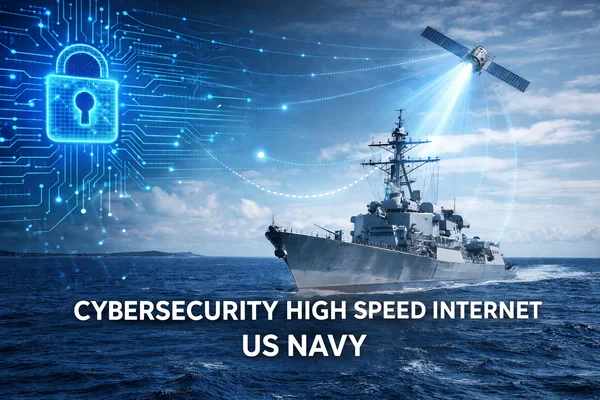
Imagine being in the middle of the ocean on a giant ship. You need to send important information back to base, but the connection is slow, or worse, someone is trying to steal your message. This is a real challenge faced by our military every day. In the digital age, reliable communication is just as important as having strong ships or fast planes. The relationship between cybersecurity high speed internet us navy operations is critical for keeping our sailors safe and our country secure.
- The Growing Need for Connectivity at Sea
- How Satellite Internet Powers the Fleet
- Understanding the Cyber Threat Landscape
- Balancing Speed with strict Security
- The “Information Warfare” Approach
- Improving Quality of Life for Sailors
- Challenges with Legacy Systems
- Project Overmatch: The Future of Naval Networking
- Training the Next Generation of Cyber Defenders
- Comparison: Commercial vs. Naval Internet
- Partnering with Private Industry
- Conclusion
Modern naval warfare isn’t just about battleships and submarines anymore. It is about data. From tracking weather patterns to coordinating with allies, the Navy relies heavily on the internet. But with great connectivity comes great risk. Cyber threats are always evolving, meaning the Navy must constantly update its defenses while trying to maintain fast, reliable internet speeds at sea.
Key Takeaways
- High-speed internet is essential for modern naval operations and crew morale.
- Cybersecurity threats are a major concern for military networks.
- The Navy uses advanced technology to balance speed with security.
- Satellite communication plays a huge role in keeping ships connected.
- Future developments focus on faster, safer, and more resilient networks.
The Growing Need for Connectivity at Sea
For a long time, ships at sea were isolated. Communication was limited to radio signals and slow data transfers. Today, that has changed completely. The demand for cybersecurity high speed internet us navy capabilities has exploded. Ships are now floating data centers. They have sensors, weapons systems, and communication tools that all need to talk to each other instantly. If the internet connection lags, it could mean a delay in critical intelligence during a mission.
Beyond mission requirements, there is the human element. Sailors are deployed for months at a time. Being able to video chat with family, stream a movie, or take online classes helps them stay connected to home. This boosts morale significantly. However, providing this “quality of life” internet access presents a unique challenge. The Navy has to make sure that a sailor checking email doesn’t accidentally open a door for a hacker to enter the ship’s classified systems.
How Satellite Internet Powers the Fleet
So, how do you get Wi-Fi in the middle of the Pacific Ocean? You can’t exactly plug a router into a wall. The answer lies in satellites. The US Navy relies on a complex network of military and commercial satellites to beam data down to ships. This is often referred to as SATCOM (Satellite Communications). These satellites orbit the Earth and act as mirrors, bouncing signals between ships and ground stations.
However, satellite internet has historically been slower than the fiber optic cables we use on land. It also faces issues like “latency,” which is the delay it takes for a signal to travel to space and back. To fix this, the Navy is investing in Low Earth Orbit (LEO) satellites. These satellites are closer to Earth, which means faster speeds and lower latency. This shift is a huge step forward in improving the cybersecurity high speed internet us navy infrastructure, making it harder for enemies to jam signals.
Commercial vs. Military Satellites
While the military has its own satellites, they also rent space on commercial ones. This helps handle the huge amount of data they use. But mixing military data with commercial networks requires strict security protocols to keep sensitive information safe.
Understanding the Cyber Threat Landscape
The ocean is big, but the digital world is even bigger and full of threats. Cyberattacks can come from anywhere: hostile nations, criminal groups, or even individual hackers. For the Navy, the stakes are incredibly high. A successful cyberattack wouldn’t just steal credit card numbers; it could disable a ship’s navigation, mess with weapons systems, or leak the location of a fleet. This is why cybersecurity high speed internet us navy strategies are top priority.
Hackers often look for the weakest link. sometimes, that isn’t the encrypted military channel, but a third-party vendor or a personal device connected to the ship’s welfare network. The Navy has to constantly monitor for “phishing” attempts, malware, and other digital viruses. They employ teams of cyber warriors whose only job is to watch the networks, hunt for intruders, and patch holes in the digital defense walls before the bad guys find them.
Balancing Speed with strict Security
We all hate it when our internet is slow. Now imagine that slowness is caused by security software checking every single packet of data. That is the trade-off the Navy faces. Heavy encryption—scrambling data so only authorized people can read it—takes computing power and can slow down transmission speeds. The goal is to find the “Goldilocks” zone: fast enough for real-time operations, but secure enough to keep secrets safe.
To achieve this, the Navy uses a concept called “defense in depth.” This means they don’t rely on just one lock on the door. They have layers of security. If a hacker gets past the firewall, they hit an encryption wall. If they break that, they might trigger an alarm system. By layering these defenses, the Navy ensures that even if one part of the system is compromised, the core cybersecurity high speed internet us navy networks remain operational and secure.
The Role of Encryption
Encryption works like a secret code. Even if a hacker intercepts a message sent from a ship, all they will see is a jumble of random characters. Without the digital “key” to unlock it, the data is useless to them.
The “Information Warfare” Approach
The Navy has actually created a specific community for this called Information Warfare (IW). These are the professionals who specialize in intelligence, meteorology, communications, and cyber operations. They treat the internet spectrum just like a physical battlefield. In their view, controlling the digital space is just as important as controlling the sea or the air.
IW officers ensure that the cybersecurity high speed internet us navy systems are robust. They plan for scenarios where the internet might be cut off entirely (called a “denied environment”). In these cases, ships must be able to operate autonomously or switch to backup communication methods. This preparation is crucial because, in a real conflict, the first thing an enemy might try to do is jam communications or cut undersea cables. Being prepared for a “digital blackout” is a key part of their defense strategy.
Improving Quality of Life for Sailors
We mentioned morale earlier, but it deserves a deeper look. Recruitment and retention are big issues for the military. Young people joining the Navy today have grown up with smartphones in their hands. The idea of going months without social media or texting is a hard sell. To keep talented people in the service, the Navy has rolled out initiatives like “Sailor 2025” which aims to improve the personal and professional lives of sailors.
A big part of this is better internet access. The Navy has been upgrading bandwidth on ships specifically for personal use. This program, often called “welfare Wi-Fi,” allows sailors to manage their bank accounts, take college courses, and keep in touch with spouses and children. However, this separates the “operational” network from the “personal” network physically and digitally. This separation is vital to ensure that a virus from a sailor’s personal laptop doesn’t jump over to the ship’s navigation computer.
Challenges with Legacy Systems
One of the biggest headaches for naval engineers is dealing with old technology. Ships are built to last for decades. An aircraft carrier built in the 1990s was designed before Wi-Fi was even common. Retrofitting these massive steel beasts with modern fiber optics and servers is difficult and expensive. These older systems are often referred to as “legacy systems.”
Legacy systems can be hard to secure because they weren’t built with modern cyber threats in mind. Sometimes, the software they run is so old that the manufacturer doesn’t even make security updates for it anymore. The Navy has to build “wrappers” or special defenses around these old systems to keep them safe. It is a constant game of catch-up to ensure that the cybersecurity high speed internet us navy standards are met, even on ships that are older than the sailors serving on them.
Project Overmatch: The Future of Naval Networking
The Navy has a massive project underway called “Project Overmatch.” The goal is simple but ambitious: to connect every ship, plane, submarine, and unmanned drone into a single, massive naval network. Think of it like a militarized “Internet of Things.” If a drone sees a threat, it can instantly share that data with a destroyer miles away, which can then launch a defense.
Project Overmatch relies heavily on Artificial Intelligence (AI) and machine learning. These computers can manage the flow of data much faster than humans can. They can automatically route data through the fastest and safest path, whether that is a satellite link or a radio signal. This project represents the future of cybersecurity high speed internet us navy integration, ensuring that the US Navy maintains a tactical advantage over any potential adversary by making faster decisions.
Training the Next Generation of Cyber Defenders
You can have the best firewalls in the world, but if a sailor writes their password on a sticky note, the system is vulnerable. Human error is the number one cause of cybersecurity breaches. Because of this, the Navy invests heavily in training. Every sailor, from the cook to the admiral, has to undergo annual cyber awareness training.
They learn about identifying phishing emails, the dangers of plugging unknown USB drives into computers, and operational security (OPSEC). For those who want to specialize, there are dedicated career paths in cyber warfare. These sailors go to specialized schools to learn ethical hacking, network defense, and digital forensics. It is a high-demand field, and the skills they learn translate very well to civilian jobs later on. This focus on education ensures the cybersecurity high speed internet us navy infrastructure is protected by smart people, not just smart software.
Comparison: Commercial vs. Naval Internet
To better understand the differences, let’s look at how your home internet compares to what is used on a Navy ship.
Feature | Home Internet | US Navy Ship Internet |
|---|---|---|
Connection Type | Cable, Fiber, or 5G | Satellite (SATCOM), Radio, Line-of-Sight |
Primary Goal | Speed and Streaming quality | Security and Mission Reliability |
Availability | 99.9% uptime (usually) | Variable (weather, location, jamming) |
Latency | Low (good for gaming) | High (due to signal travel to space) |
Security | Basic Firewall / Antivirus | Military-grade Encryption, Air-gapped networks |
Cost | Monthly subscription | Multi-million dollar infrastructure |
Partnering with Private Industry
The Navy knows it cannot solve every problem alone. Technology moves too fast. Silicon Valley innovates faster than the Pentagon can write contracts. To keep up, the Navy partners with private tech companies. They look for innovative solutions in cloud computing, data compression, and 5G technology.
For example, 5G networks are starting to be tested on military bases and even some ships. 5G promises incredibly fast speeds and low latency, which is perfect for moving large amounts of data. By working with industry leaders, the Navy can adopt these commercial technologies and adapt them for military use. It is a smart way to improve cybersecurity high speed internet us navy capabilities without having to invent everything from scratch.
Brand Mention
Technology moves fast in the civilian world too. For the latest updates on tech trends and digital lifestyle news, you can check out resources like Trand Magazine. Keeping an eye on civilian tech often gives us clues about where military tech is heading next.
Conclusion
The digital ocean is just as dangerous as the physical one. The United States Navy faces a difficult task: keeping its fleet connected with high speeds while locking down every digital hatch against cyber pirates and enemy nations. The integration of cybersecurity high speed internet us navy systems is not just a luxury; it is a necessity for modern warfare and sailor well-being.
From leveraging satellites in space to training sailors on the ground, the Navy is fighting a battle on the invisible front of data. As technology like AI and 5G continues to advance, the Navy will continue to adapt. The goal remains the same: to ensure that when a message needs to be sent, it gets there fast, and it gets there safe.
FAQ
Q: Why is internet on Navy ships slower than at my house?
A: Ships rely on satellite connections, which have to travel thousands of miles into space and back. This distance creates delays (latency) and slower speeds compared to fiber optic cables used on land.
Q: Can sailors use social media on ships?
A: Generally, yes. However, access is often restricted based on the ship’s mission and bandwidth availability. There are strict rules about what they can post to ensure they don’t reveal sensitive location data.
Q: What is Project Overmatch?
A: It is a US Navy initiative to connect all its assets (ships, planes, sensors) into one giant, secure network to share data instantly and improve decision-making during combat.
Q: Is the Navy using Starlink?
A: The Navy is testing and using various Low Earth Orbit (LEO) satellite services, including Starlink, to assess how they can improve connectivity and morale for sailors at sea.
Q: What is the biggest threat to Navy cybersecurity?
A: While sophisticated hackers are a threat, human error (like clicking a bad link or using weak passwords) remains one of the biggest risks to any secure network.